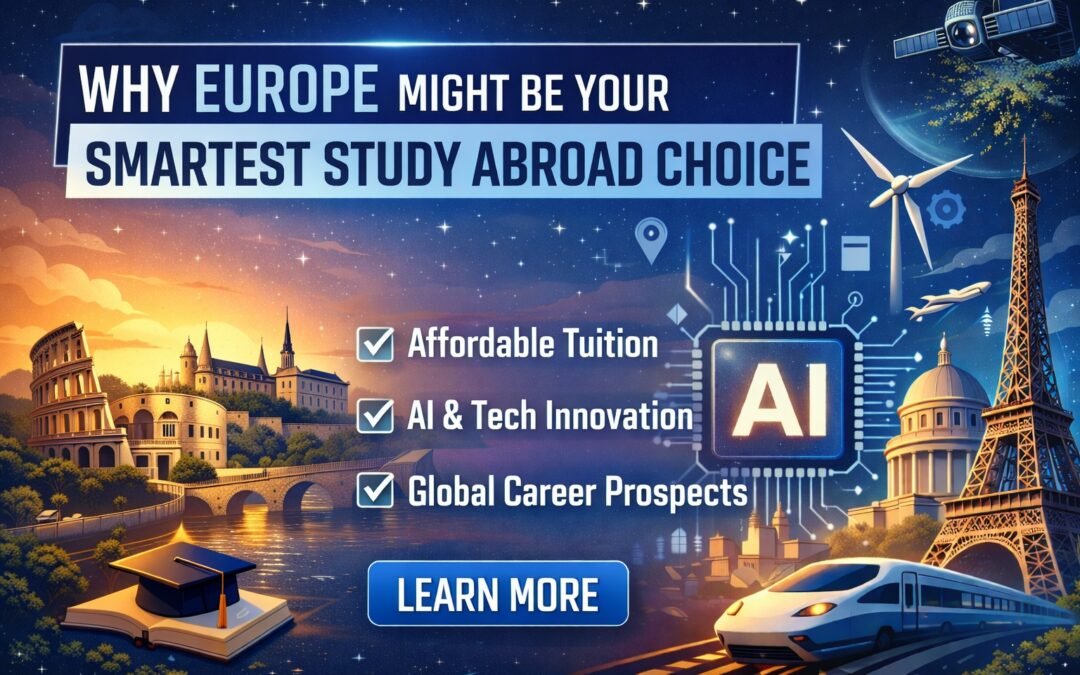
Honestly? Europe Might Be the Best Decision You Never Considered
A real talk about why thousands of students every year pack up, head to Europe, and never look back, and why you might want to join them.
From AI labs in Helsinki to climate innovation hubs in Amsterdam, why the world’s brightest students choosing Europe to shape the future?
The Case for Europe
When most students think about going abroad for university, they picture two places: the US or the UK. Big names. Big campuses. Big price tags. But here’s what nobody tells you early enough: Europe has quietly become one of the most exciting, affordable, and genuinely life-changing places in the world to get a degree. And a lot of students are figuring this reality out too late.
I’m not talking about some nostalgic “study in a medieval town and find yourself” fantasy. I’m talking about world-class research labs, programs taught entirely in English, cities that run on clean energy, and, in some countries, completely free tuition in public universities. Yes, even for international students.
Quick reality check: A full master’s degree in Germany or Norway can cost you less than one semester’s tuition at a mid-tier American university. The quality? Frequently higher. Let that sink in.
“The university of the future is not a building, it is a borderless intellectual ecosystem.
And Europe, right now, is building exactly that.”
— Education Futures Forum, Davos 2025
So, Why Now? What’s Changed?
The timing actually matters here. The world is going through a massive shift. AI is changing every industry, climate change is reshaping what careers look like, and the ability to work across cultures and borders is no longer a “nice to have.” It’s essential.
European universities have moved fast to respond to all of these changes. They’re not just adding AI modules to old degrees; they’re building brand new programmes where students work alongside AI tools from day one. Climate science, green engineering, and circular economy thinking isn’t an elective here; it’s baked into the curriculum across nearly every field.
And the geopolitical reality? Studying in Europe, surrounded by 26 different countries, dozens of languages, and students from over 120 nationalities, that’s not just education. That’s training for the world you’re actually going to work in.
- 50+ countries sending students to Europe
- 4M+ international students enrolled in EU
- 40% more AI research papers from EU vs 2020
- 26 countries in the Schengen travel zone
- Six Reasons to Choose Europe
01 Radically Low Tuition
Germany, Norway, and Finland charge little to no tuition for international students. France and Austria offer world-class education for a few hundred euros per year, a revolution in academic access.
02 AI & Deep Tech Labs
From ETH Zurich’s robotics halls to Stockholm’s fintech incubators, European campuses are where the next generation of transformative technology is actually being built, not just theorised.
03 Green Futures at the Core
Climate science, renewable energy, and circular economy design are woven into programmes across disciplines. Study engineering in Denmark and you will work on wind farm simulations as a first-year student.
04 One Continent, Infinite Campuses
The Erasmus+ programme lets students move freely between partner universities across 33 countries, often with grants to cover travel and living costs. Your degree can span three countries.
05 The World in One Classroom
European cities are among the world’s most culturally layered. Study alongside peers from 120 nationalities and leave with a global network and a genuinely multicultural worldview.
06 Institutions With Centuries of Depth
The University of Bologna was founded in 1088. Oxford in 1096. These are not just credentials; they are living intellectual traditions that continue to shape how knowledge is created and shared.
The Movements Reshaping European Education
01 Human-AI Collaborative Degrees
From Helsinki to Barcelona, universities are building programmes where students don’t just study AI they use it as a research partner. You learn to direct it, question it, and govern it ethically. That’s a fundamentally different kind of education than reading a textbook about machine learning.
02 The Climate Campus Revolution
Sustainability isn’t a buzzword. The EU’s Green Deal has funnelled billions into academic research infrastructure. New interdisciplinary schools of “planetary health” are emerging that combine ecology, economics, law, and engineering into programmes designed explicitly to address the climate emergency.
03 New Model: Studying in four campuses at once
The EU’s flagship academic project links over 60 university alliances across member states into transnational institutions. Students in one country can earn joint degrees with peers on four campuses simultaneously, a genuinely new model of higher learning that has no parallel elsewhere in the world.
04 Quality of Life as a Learning Metric
Scandinavian universities now treat student wellbeing as a core educational outcome. Flexible schedules, mental health integration, work-life balance policies, and universal healthcare coverage mean that studying in Europe is not just intellectually enriching; it is restorative.
05 English-Taught Programmes Explode
Over 10,000 fully English-taught Master’s programmes now operate across continental Europe, a fourfold increase since 2015. The language barrier that once dissuaded international students has largely dissolved, opening the continent to a truly global cohort.
✦ ✦ ✦
The best education is the one that changes
not just what you know —
but who you become.
Europe offers centuries of wisdom, a living laboratory of cultures, and front-row access to the technologies defining the next hundred years. The question is no longer why you should come. It is why you would go anywhere else.
A Final Word
- Europe does that. Living and studying in a place where history, innovation, and radical openness coexist affects you. It stretches you in the best possible way.
- The students who are going to lead things in the 2040s are deciding where to study right now. Some of them will choose safely and locally. Others will choose an education that takes them somewhere new and challenges their beliefs.
- Pack your bags. The continent is waiting.
FAQs
1. Why is Europe becoming a popular study abroad destination?
Europe is becoming a popular choice because it offers high-quality education, lower tuition in many countries, strong career opportunities, and access to multicultural learning environments.
2. Is studying in Europe affordable for international students?
Yes, many European countries offer affordable tuition, and some public universities charge little to no tuition fees. Compared to other major study abroad destinations, Europe can be a more cost-effective option.
3. Can international students study in Europe in English?
Yes, thousands of programmes across Europe are taught entirely in English, especially at the master’s level, making it easier for international students to apply without needing to learn a new language first.
4. Which European countries are best for international students?
Popular choices include Germany, France, the Netherlands, Sweden, Finland, Ireland, and Denmark, depending on the student’s course, budget, and career goals.
5. Is Europe better than the US or UK for studying abroad?
That depends on the student’s priorities. For many students, Europe offers a better balance of affordability, academic quality, cultural exposure, and future-focused education.
6. Are European universities good for AI, technology, and innovation?
Yes, many European universities are known for strong research, innovation, and industry-linked programmes in areas like AI, robotics, engineering, sustainability, and fintech.
7. What are the benefits of studying in Europe?
Students benefit from quality education, lower costs, international exposure, access to multiple countries, diverse classrooms, and programmes aligned with emerging global careers.
8. Can students travel while studying in Europe?
Yes, one of Europe’s biggest advantages is its connectivity. Students often have the chance to travel across neighbouring countries and experience different cultures during their studies.
9. Does studying in Europe help with global career opportunities?
Yes, studying in Europe can help students build international exposure, cross-cultural communication skills, and a broader professional network, which are valuable in global careers.
10. How do I choose the right university in Europe?
Students should consider their course, tuition budget, language of instruction, career plans, location preferences, and post-study opportunities before making a decision.